The Eye That Sees Gold in Gravel
Julie Harkin doesn't look like someone who's changed the face of British television. Sitting in her cramped Manchester office, surrounded by headshots and half-empty coffee cups, she could be any middle-aged Northern woman having a brew. But appearances deceive. Over the past thirty years, Harkin has cast more BAFTA winners than any other agent north of Watford Gap—and she's done it by trusting her instincts over industry conventions.
"I don't care if they've been to RADA," she says, shuffling through a pile of applications. "I care if they can make me believe they're someone else. And you don't learn that in drama school—you either have it or you don't."
Harkin's philosophy isn't unique among Northern casting directors, but her success rate certainly is. She's the woman who put Christopher Eccleston in his first television role, who convinced producers that a unknown Rochdale lad called Suranne Jones could carry a prime-time drama, and who fought tooth and nail to get Sean Bean cast in Sharpe when everyone else thought he was 'too Northern' for a period piece.
The Working-Class Whisperers
What sets Northern casting agents apart isn't just their eye for talent—it's their understanding of authenticity. When London casting directors look for 'ordinary' people, they often end up with drama school graduates pretending to be working class. When Northern agents look for ordinary people, they find the real thing.
"There's something about growing up around proper working people that gives you an ear for bullshit," explains Tommy Flanagan, who's been casting for Yorkshire-based productions for over twenty years. "You can spot a fake accent from a mile off, and more importantly, you can spot someone who's never done a proper day's work in their life."
Flanagan's breakthrough came in the early 1990s when he convinced Emmerdale producers to cast unknown locals alongside established actors. The result was a generation of performers who didn't just play Yorkshire farmers—they understood them from the inside out.
"I'd rather have someone who's mucked out stables than someone who's studied method acting," he laughs. "At least I know they understand what hard work looks like."
The Pub Circuit Revolution
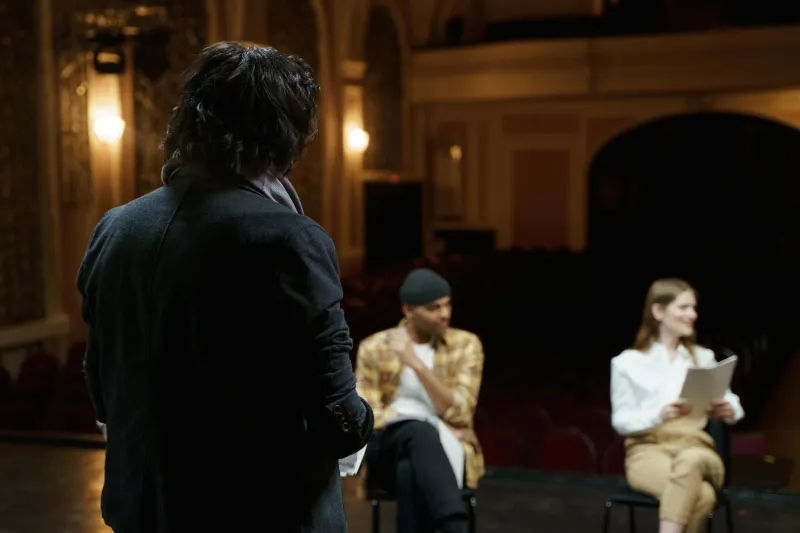
While their London counterparts hold casting calls in expensive West End studios, Northern talent hunters have developed an entirely different approach: they go where the people are. Pub quiz nights, amateur dramatics societies, working men's clubs—anywhere ordinary people might be performing, you'll find a Northern casting director taking notes.
This guerrilla approach to talent scouting has uncovered some of British television's biggest names. Sarah Lancashire was discovered performing in local theatre productions around Oldham. Mark Addy was spotted doing stand-up comedy in York pubs. Even Sir Ian McKellen got his first television break through a Northern casting director who saw him in a Manchester fringe production.
"The best actors aren't necessarily the ones queuing up at auditions," observes casting veteran Linda Stephenson, whose Blackpool-based agency has launched dozens of careers. "They're the ones getting on with their lives, working day jobs, maybe doing a bit of amateur theatre at weekends. They've got stories to tell because they've actually lived."
Breaking the Accent Barrier
For decades, British television operated on an unspoken hierarchy: posh accents for the leads, regional accents for the comedy relief. Northern casting directors didn't just challenge this system—they demolished it entirely.
The transformation didn't happen overnight. Throughout the 1980s and 1990s, Northern agents fought constant battles with London producers who worried that regional accents would alienate southern audiences. They persisted, and gradually, something remarkable happened: audiences stopped caring about accents and started caring about performances.
"I remember sending Sean Bean to audition for a period drama in the early 90s," recalls veteran Manchester agent Patricia Woods. "The London producer literally asked if he could 'sound less Northern.' I told them if they wanted a posh boy, they should have asked for a posh boy. They wanted Sean Bean."
Bean got the role, and the rest is television history.
The Authenticity Advantage
What Northern casting directors understood long before their London colleagues was that authenticity sells. Audiences can instinctively tell the difference between someone playing a character and someone inhabiting one. And the actors who inhabit characters most convincingly are often those who share their backgrounds, experiences, and worldviews.
This isn't about typecasting—it's about understanding that great acting comes from truth, not technique. A former miner can play a former miner with a depth that no amount of research can replicate. A single mother from Manchester brings something to a role that no drama school exercise can teach.
"People always ask me what I look for in an audition," says Julie Harkin. "Honestly? I look for someone who's lived a bit. Someone who's had their heart broken, worked a shit job, worried about paying the rent. Those experiences don't make you a better actor—they make you a more interesting human being. And interesting human beings make compelling television."
The Ripple Effect
The success of Northern casting hasn't just changed who appears on British television—it's changed how television is made. When working-class actors started getting leading roles, writers began creating more working-class characters. When regional accents became acceptable in prime time, regional stories became viable commercial propositions.
Today's television landscape—where shows like Happy Valley, Line of Duty, and This Is England dominate critical and commercial success—exists because Northern casting directors proved that authenticity trumps artifice every single time.
"We didn't set out to change British television," reflects Tommy Flanagan. "We just wanted to find good actors. Turns out, good actors come from everywhere—not just the places where London casting directors were looking."
The Next Generation
As streaming services and international productions reshape the television industry, Northern casting directors are adapting once again. But their core philosophy remains unchanged: find real people to play real characters, and audiences will respond.
The talent hunters are still out there, still haunting pub quiz nights and community theatre productions, still trusting their instincts over industry conventions. And somewhere in a Barnsley working men's club or a Liverpool community centre, the next Sean Bean or Sarah Lancashire is probably getting ready to step into the spotlight—they just don't know it yet.
Because that's what Northern casting directors do best: they see stars before anyone else does, including the stars themselves.