Midnight Grafters: The Overnight TV Crews Turning Northern Streets Into Sets While You Sleep
It's half two in the morning on a Tuesday. A light drizzle is settling over the cobbled streets of Salford Quays, and most sensible people in Greater Manchester are fast asleep. But not everyone. Down near the waterfront, a convoy of vans has pulled up, cables are snaking across the tarmac, and a woman in a high-vis jacket is on her third coffee of the night, gesticulating at a traffic cone arrangement with the authority of someone who genuinely cares about traffic cone arrangements.
 Photo: Salford Quays, via wallpapers.com
This is British television being made. Not the glamorous part — the essential part.
The Shift Nobody Sees
For every scene that lands on your telly, there's an entire logistical operation that happened before the principal cast arrived on set. When productions film on location across the North — whether that's a crime drama using Leeds city centre, a period piece set in York's medieval streets, or a gritty docudrama shot around Liverpool's docklands — the overnight crew is the invisible engine making it all work.
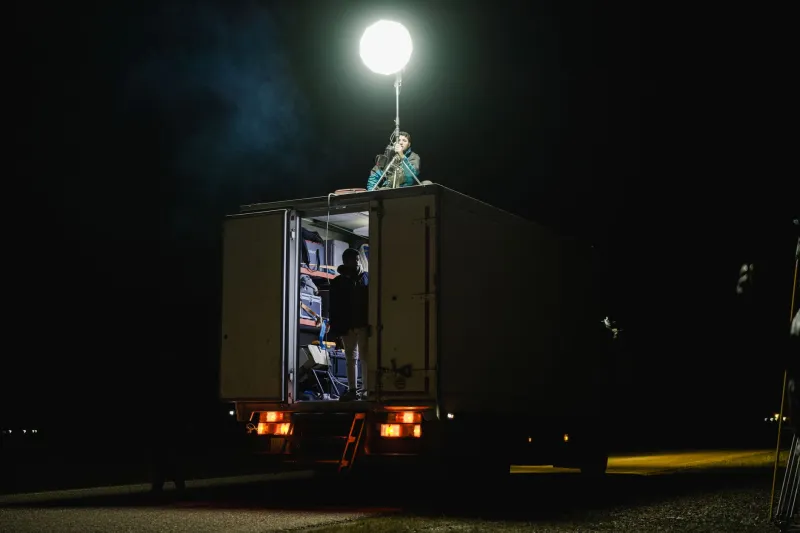
These are the traffic management specialists, the lighting riggers, the location assistants, the catering crews, the security personnel and the production runners who collectively spend their nights doing the work that daylight hours simply don't allow. Roads need closing. Lighting rigs need building. Parking restrictions need enforcing. Signage needs covering. And all of it, ideally, needs to be done without waking up half a residential street.
"The job is basically solving a hundred small problems before the director even arrives," says one location manager who has worked on several major BBC productions across the North of England. "By the time the stars turn up at six in the morning, everything should look effortless. If we've done our job right, nobody knows we were ever there."
Hull at 3am: A Different World Entirely
Hull's historic docklands have become an increasingly popular filming location in recent years, partly because of the city's raw industrial architecture and partly because it offers production companies something increasingly rare in British cities — genuine atmosphere that hasn't been smoothed away by gentrification.
But filming at Hull's waterfront at three in the morning brings its own particular challenges. The tidal nature of the estuary means lighting setups need to account for changing water levels. The fog that rolls in off the Humber can be atmospheric gold for a cinematographer and a complete nightmare for a location manager trying to keep sight lines clear for safety.
"We had one night where the fog came in so thick you genuinely couldn't see the far bank," recalls a production assistant who worked on a recent ITV drama shot partly in the city. "It looked incredible on camera, actually. But we spent two hours reconfiguring the generator positions because the original plan assumed you could see where you were going."
The overnight crews working in Hull talk about the city with real affection. There's a sense that the North's less-celebrated locations — not Manchester, not Leeds, but the places in between — reward the people willing to be there at ungodly hours with something the glossier cities can't quite replicate.
The Logistics of Locking Down a Street
Getting permission to film on a public road is one thing. Actually executing a road closure in the middle of the night, in a way that doesn't cause chaos for early-morning commuters or generate noise complaints from nearby residents, is something else entirely.
Traffic management companies that specialise in television and film work have become a quietly booming sector across the North. Firms based in Salford, Sheffield and Newcastle have developed expertise in the specific rhythms of production schedules — understanding that a director might need a particular junction closed from midnight to five, then open again before the morning rush, then potentially closed again the following night.
"You're essentially working backwards from the shot list," explains one traffic management supervisor who has worked on productions in Manchester, Bradford and along the Tyne. "The director needs a clean street by this time, so we work out what that means in reverse. What time do we start? How many cones? Which diversions? It's surprisingly mathematical."
The paperwork alone is substantial. Overnight filming on public roads requires coordination with local councils, police liaison officers, and sometimes utility companies if cables are crossing pavements. The overnight crew handles most of this administration in advance, but things change — and the ability to adapt quickly, quietly, and without disturbing anyone, is what separates the good crews from the great ones.
Catering for the Night Shift
Ask anyone who has worked overnight on a television production what they remember most fondly, and there's a decent chance they'll mention the catering truck. The mobile catering operations that serve overnight film crews are their own remarkable institutions — turning up in industrial car parks and windswept locations to produce hot food at four in the morning with the cheerfulness of people who have simply decided that time is a social construct.
Across the North, several catering companies have built reputations specifically on their ability to keep overnight crews fed and functional. Proper hot meals, not just sandwiches. The kind of food that makes a 3am lighting rig feel slightly more bearable.
"People underestimate how much the food matters," says one camera operator who has worked extensively on location across Yorkshire and Lancashire. "When it's cold, it's dark, you've been on your feet for six hours, and someone hands you a proper beef stew from a truck in the middle of nowhere — that's what keeps the whole thing going."
The Stamina Required
There's a reason overnight television work tends to attract a particular type of person. The hours are brutal by any conventional measure. A typical overnight shoot might run from eight in the evening until six the following morning, with crew members often required back on set within twelve hours for the next preparation phase.
The physical demands are real — heavy equipment, outdoor locations in Northern winters, the particular exhaustion that comes from working against your body's natural rhythms. But the people who do this work consistently describe it with something approaching pride.
"There's a camaraderie to it that you don't really get in an office," says one rigger who has worked on productions across the North for over a decade. "When you're all cold and tired and you've just solved some complicated problem at four in the morning, there's a bond there. You're in it together in a way that's quite unique."
The North's television industry — centred increasingly around the Media City complex in Salford but spreading across the region — depends on these people in ways that rarely get acknowledged in the credits. The midnight grafters, the overnight fixers, the people who make the streets ready for the cameras by the time the rest of us are making our morning tea.
They deserve a round of applause. Or at the very least, a decent beef stew.