The Tape Hoarders: Meet the Northern Fans Racing to Save TV That Broadcasters Threw Away
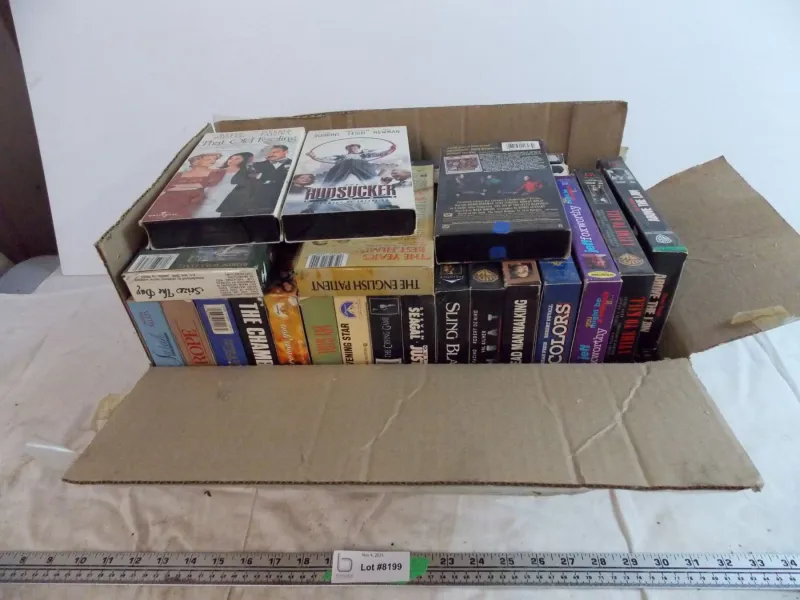
Photo: old VHS tapes collection dusty loft storage boxes, via dygtyjqp7pi0m.cloudfront.net
The loft smells of dust and old plastic. Cardboard boxes are stacked three high along one wall, each one labelled in neat biro: Granada 1987–89, YTV Misc, Look North Specials, DO NOT RECORD OVER. That last instruction is underlined twice.
Dave, who asked us not to use his surname, has been collecting regional television recordings for the better part of thirty years. He started when he was a teenager, setting the family VHS recorder before school and watching the tapes back in the evenings. He never really stopped. What began as an enthusiast's habit has quietly become something more significant: an unofficial archive of Northern television programming that, in many cases, exists nowhere else on earth.
"I've got stuff up here that the broadcasters themselves don't have," he says, not with pride exactly, but with a kind of weary disbelief. "Chat shows, regional news specials, local magazine programmes — things that were made for people in this region, about people in this region, and then just... gone. Wiped. Taped over. Binned. I've got the only copy."
The Wiping Epidemic
To understand why people like Dave exist, you need to understand the catastrophic scale of what British television lost in the decades when nobody thought archive footage was worth keeping.
From the 1950s through to the 1980s, broadcast tapes were routinely wiped and reused because the raw materials were expensive and storage space was limited. The BBC famously lost huge swathes of its early output this way — entire runs of classic programmes, gone forever. But the national conversation about those losses tends to focus on London-made content. The destruction of regional programming was just as severe, and has received a fraction of the attention.
Local news magazines, regional arts programmes, community features, dialect documentaries — the kind of telly that was made specifically for the North, by people in the North, capturing communities and conversations that have now changed beyond recognition. Most of it is simply gone from official channels. What survives does so largely by accident, in the collections of people who had the foresight — or the obsession — to hit record.
The Underground Network
Dave isn't operating in isolation. Over the years, through online forums, Facebook groups, and the occasional in-person meet-up at a pub function room in Harrogate, he's become part of a loose community of like-minded collectors spread across Yorkshire, Lancashire, the North East, and beyond.
They swap information, trade duplicates, and tip each other off when something surfaces at a car boot sale or in a deceased estate. One member of the group — a retired teacher from Stockton-on-Tees — recently unearthed a near-complete run of a regional arts programme from the early 1980s at a house clearance. Another, based in Oldham, has been systematically digitising his collection for the past five years, uploading carefully indexed files to a shared private server that members can access.
Technically, much of this activity occupies a legal grey area. The content is still under copyright. Nobody has licensed these recordings. The people doing the uploading know this, and most of them are comfortable with the moral logic even if the legal position is uncomfortable: if the rights holders aren't preserving the material and aren't making it available, what exactly is being protected?
"I've contacted broadcasters," says one collector from Middlesbrough, who goes by the username Teesside_Telly in the forums. "I've written to archives, I've emailed heritage organisations. Sometimes you get a polite reply. Mostly you get nothing. They're not interested. But they'd also be furious if I uploaded the stuff publicly. It's maddening."
What's Actually Being Saved
The material these collectors are sitting on is, in some cases, genuinely remarkable — not just as curiosity, but as historical record.
There are local news features from the 1970s documenting communities in the middle of industrial transition — steelworks closing, mining towns bracing for what's coming, ordinary people talking about their lives with an unguarded candour that scripted drama can never quite replicate. There are regional magazine programmes featuring local musicians who went on to national fame, captured in early performances that nobody knew to document properly at the time. There are dialect programmes, community arts features, school holiday specials — the texture of Northern life at specific moments in time, preserved on deteriorating magnetic tape.
Digitising that tape is urgent work. VHS degrades. Betamax degrades faster. Even if the content survives, the format it's stored on is dying, and every year that passes without a digital transfer is a year closer to losing it permanently.
"People think because it's on a tape it's safe," says Dave, pulling out a cassette that's visibly warped along one edge. "It's not. I've lost recordings I thought I had. You open the case and the tape's just... eaten itself. That's a piece of history gone. You can't get it back."
The Institutions That Should Be Doing This
It would be unfair to say that nobody in an official capacity cares about regional television heritage. The BFI National Archive holds significant material, and organisations like the North West Film Archive at Manchester Metropolitan University do genuinely important preservation work. But resources are finite, priorities compete, and the sheer volume of what was produced — and lost — at a regional level means that gaps remain enormous.
The collectors in Dave's network aren't positioning themselves as rivals to these institutions. Most of them would be delighted to hand their material over to a properly funded archive that could care for it professionally. The problem is that the pathway from private collection to official preservation is neither straightforward nor well-signposted.
"I want this stuff to be properly looked after," Dave says, gesturing at the boxes. "I'm not trying to hold it hostage. I'm trying to keep it alive until someone with more resources than me can take it on. That's all."
Until that day comes, the tapes stay in the loft. The digitising continues. And a group of quietly dedicated Northerners carries on doing, in their spare bedrooms and attic spaces, the cultural preservation work that should have been done officially — and wasn't.
Somebody has to.