While You Were Sleeping: A Night With the Crews Who Build British Telly Before Breakfast
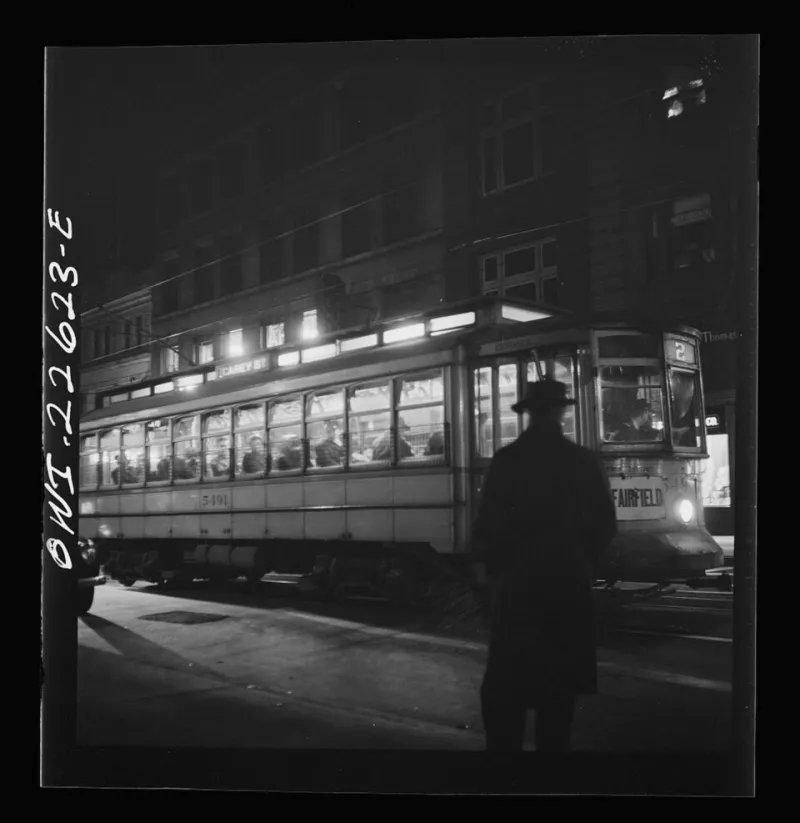
Photo: Marjory Collins, Public domain, via Wikimedia Commons
It's twenty past eleven on a Tuesday in November, and a street in inner Leeds is in the process of disappearing.
Not literally — the terraced houses are staying put, the corner shop is still there, and the pub at the end of the row is, judging by the noise, still very much operational. But the twenty-first century is being carefully, methodically dismantled. A parked car has been moved. A satellite dish has been covered. New signage — hand-painted, deliberately faded — is going up over the off-licence. A skip arrives, is positioned, and is immediately filled with a selection of period-appropriate rubbish sourced from a specialist supplier in Huddersfield. By 6am, when the first camera unit arrives, this street will be somewhere else entirely. Sometime else, too.
The people doing this work will, by that point, be gone.
The Invisible Shift
Location dressing for television production is one of those jobs that exists in a strange professional paradox: the better you do it, the less anyone knows you were there. Success is invisibility. The night crew's entire purpose is to leave no trace of their own presence while simultaneously transforming everything around them.
Jodie Marchetti has been working in location dressing for eleven years, the last seven of them in the north of England. She's originally from Doncaster, trained in theatre production, and drifted into television through a contact she made on a student film shoot in Sheffield. Tonight she's supervising a team of eight, working a stretch of Leeds street for a drama series that she's contractually unable to name but which, she implies, viewers of a certain vintage will be very pleased about.
"People ask me what I do and I say I'm a set dresser and they imagine I'm arranging flowers on a studio set," she says, pulling a list from her jacket and scanning it with a head torch. "I'm usually in a street at midnight arguing with a parking attendant about whether a 1970s Ford Cortina counts as an obstruction."
Tonight there is no parking attendant dispute, but there is a logistics chain of considerable complexity. The props truck — a long-wheelbase vehicle that has been described by its driver, Phil, as "basically a moving antique shop" — is parked at the end of the street, its contents being carefully ferried to their designated positions by Jodie's team. Each item has been pre-assigned a location on a detailed dressing map. Nothing is placed at random. Everything will be checked against continuity photographs before the night is out.
Cold Work, Careful Work
By half midnight, the temperature has dropped to something that Phil describes diplomatically as "fresh" and that everyone else describes using language unsuitable for a family entertainment website. The wind has picked up off the moors — you can feel it funnelling down the terraced rows, the particular kind of cold that gets into the gap between your collar and your neck and stays there.
Nobody seems particularly bothered. There's a rhythm to night shift work that generates its own warmth — the constant movement, the focus, the low-level camaraderie of people who've done hard things together before.
"You get used to it," says Marcus, one of Jodie's dressers, a quietly methodical man from Bradford who has been carefully installing period-appropriate curtains in a ground-floor window for the past twenty minutes. "First winter you do this job, you think you'll die. After that you just get better thermals."
The lighting riggers are working further down the street, running cable with the practiced efficiency of people who've done this so many times the process has become almost automatic. Their job is to pre-position the lighting infrastructure so that when the gaffer arrives in the morning, the bulk of the groundwork is already done. It's unglamorous, physical work — hauling cable drums, climbing rigs, testing connections in the dark — but the expertise involved is considerable. Get it wrong and you waste the morning. Get it right and nobody notices.
Dave Sowerby, a senior rigging electrician from Wakefield who has worked on productions across the north for fifteen years, has a particular affection for night shifts that his colleagues find slightly baffling. "It's quiet," he explains, which is technically true, though not entirely convincing given that he's currently operating a piece of equipment that sounds like a particularly angry lawnmower. "You can think. During the day there's always someone wanting something. At night you just get on with it."
The 3am Hour
There's a particular quality to the small hours on a location shoot that defies easy description. By 3am, the street has been substantially transformed. The dressing is largely in place. The rigging is progressing. Someone has produced a flask of tea from somewhere and it's being passed around with the communal reverence of something genuinely precious.
Jodie is walking the street with her dressing map, checking items against the pre-production photographs, making small adjustments. A curtain is fractionally wrong. A piece of signage needs to come down two inches. A dustbin — period-correct, sourced from a reclamation yard in Harrogate — has been placed slightly too close to a drain cover that will be in shot.
This is the granular reality of the work: an endless sequence of small decisions, each individually trivial, collectively critical. The director won't think about the dustbin. The audience won't think about the dustbin. But if the dustbin is wrong, something will feel slightly off, and that slight wrongness will accumulate with other slight wrongnesses until the viewer, without knowing why, feels less convinced by what they're watching.
"It's about truth," Jodie says, moving the dustbin three inches to the left and studying the result. "You're trying to make something that feels true. The audience knows, somewhere below conscious thought, when things are true and when they're not. Our job is to make sure they feel true."
Dawn and Departure
By 5am, the work is essentially done. The street has become what the script requires it to be. The night crew are packing their tools, loading residual equipment back onto the truck, removing every trace of their own operation. When the camera unit arrives at six, they will find a dressed location and nothing else — no evidence of the hours of work that created it, no sign of the eight people who spent the night in the cold making it possible.
Jodie does a final walk of the street as the sky begins to lighten almost imperceptibly to the east. She checks her list. She checks the photographs. She checks the dustbin.
"Right," she says, to no one in particular. "That'll do."
By the time the director of photography is framing their first shot of the morning, Jodie and her crew will be in a van heading back to the depot, some of them already asleep against the windows. The street they leave behind them will appear, in a few months' time, on television screens across the country. Viewers will accept it without question as a real place, a true place, a place with history and texture and life.
They won't think about how it got that way. That's exactly as it should be.